Your license is on the line. Run an audit-ready office.
Every licensee, office policy, transaction file, trust-account entry and advertisement — dated, acknowledged, reconciled and retrievable. Broker Office is the supervisory back office a qualifying broker is personally answerable for, in one system that tells you what is out of compliance before anyone else asks.
The firm's paperwork is the broker's personal liability.
Agents close deals. The qualifying broker answers for how they were done — who was licensed, who was supervised, what was advertised, whose money was held and whether the file still exists three years later. Broker Office keeps that answer short.
Know who you are responsible for
Licenses, expirations, written agreements, mentors and unlicensed assistants — current at a glance, not reconstructed later.
Prove the escrow balances
A chronological journal, a ledger per beneficiary, and a monthly three-way reconciliation that ties to the bank statement.
Still have the file in year three
Required-document checklists, broker review sign-off, and a retention date that blocks deletion inside the window.
Approve it before it runs
Signs, listing ads and social posts reviewed for truthfulness, brokerage name and owner consent — with the decision on record.
The findings that actually get written up
Office inspections and complaint investigations rarely turn on the deal. They turn on the file. These are the gaps Broker Office is built to close:
- No written office policy, or a policy nobody acknowledged
- A licensee practicing on a lapsed license
- Earnest money deposited late, or held past the disbursement window
- Trust account never reconciled — or reconciled only to the bank
- An advertisement without the brokerage name, or run without owner consent
- A transaction file missing the agency disclosure or the signed agreement
- Records destroyed inside the retention period — including rejected offers
- An unlicensed assistant doing licensed work
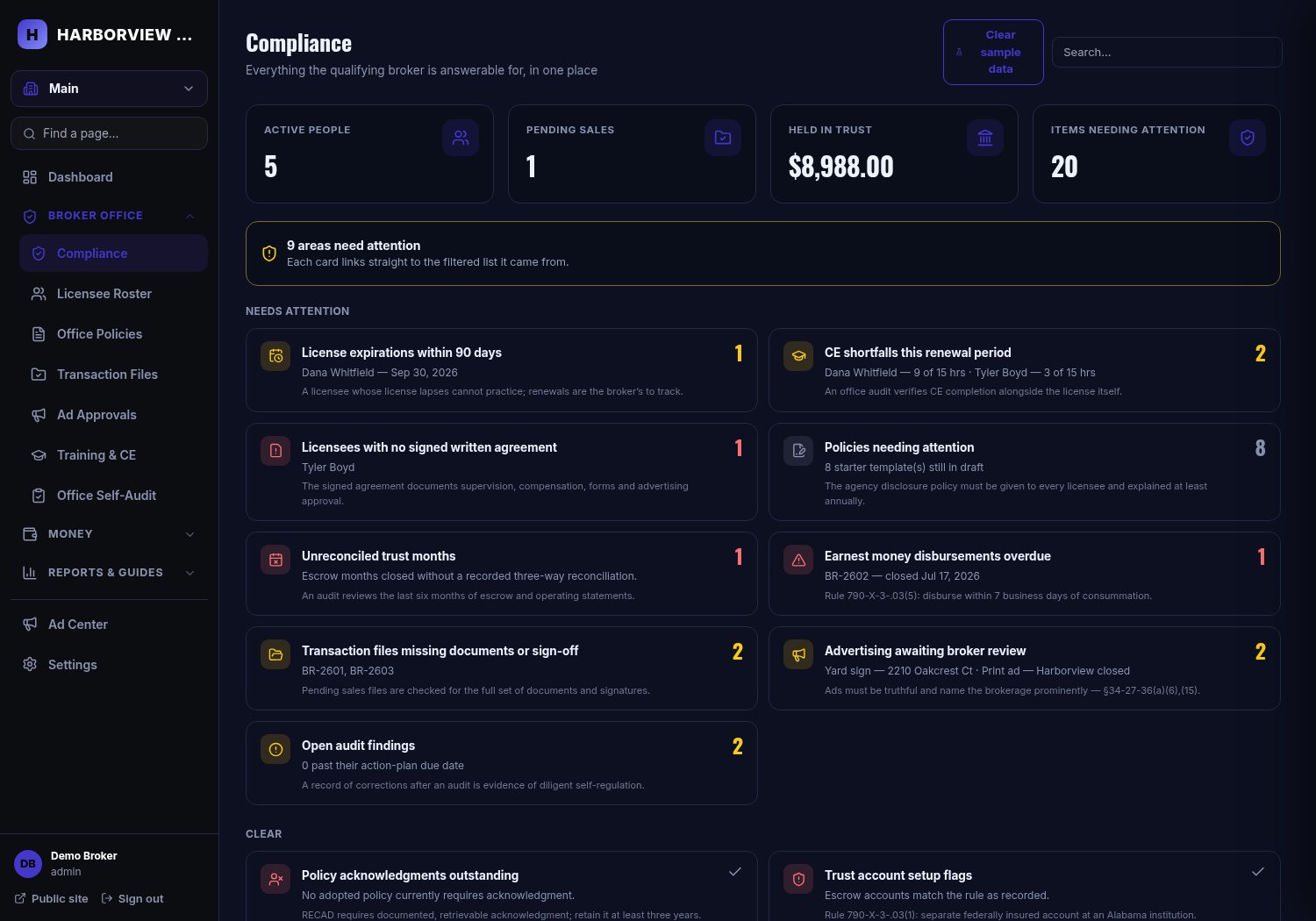
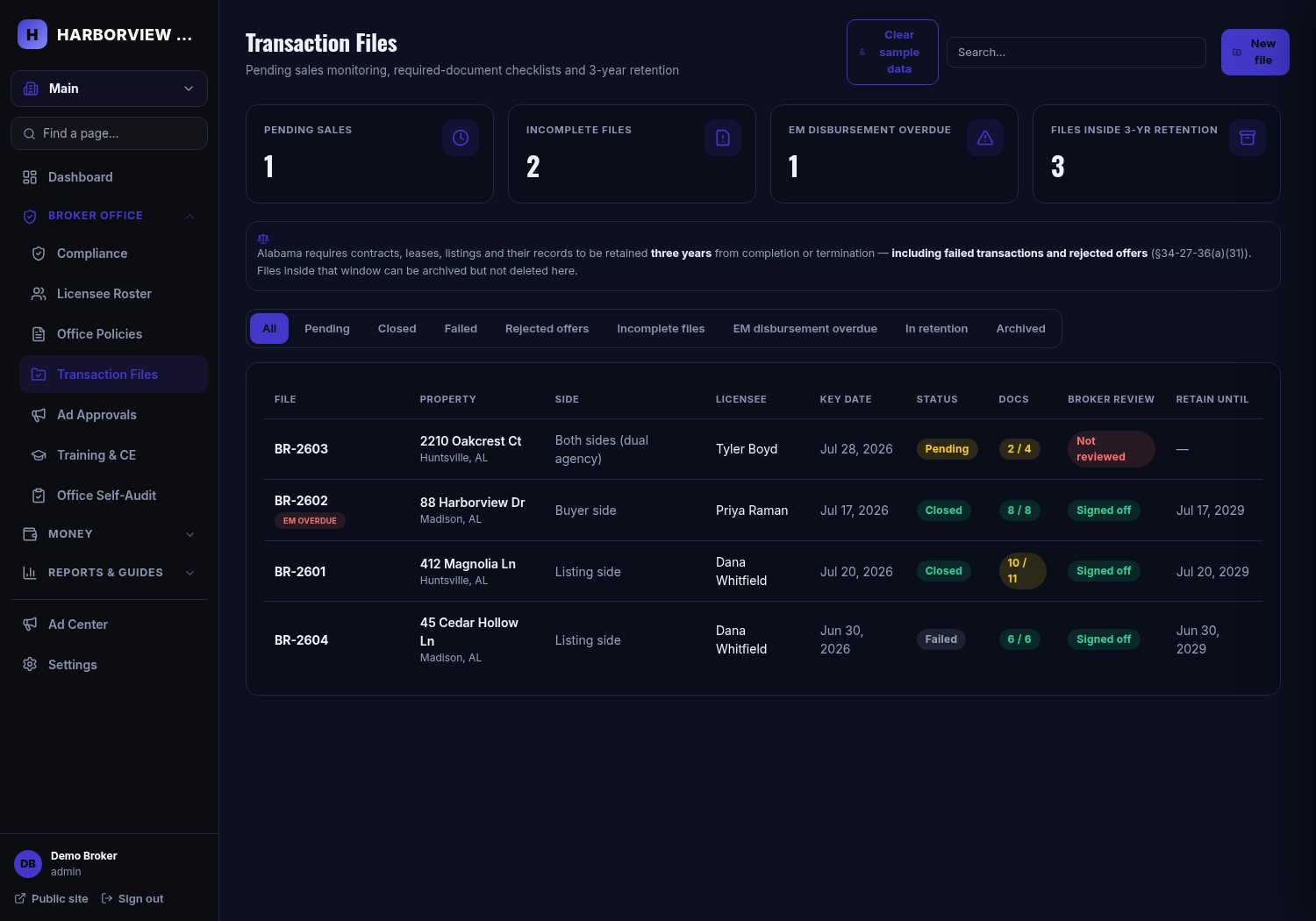
One screen that shows you what is exposed.
Instead of eight separate things to remember, every open exposure is aggregated and dated, and each alert links straight to the record it came from.
- Licenses expiring, and anyone already lapsed
- CE hours logged against hours required this renewal period
- Policies past their review date and licensees missing an acknowledgment
- Trust months with no completed reconciliation
- Earnest money still held past the disbursement deadline
- Transaction files missing documents or a broker review
- Self-audit findings whose action plan is still open
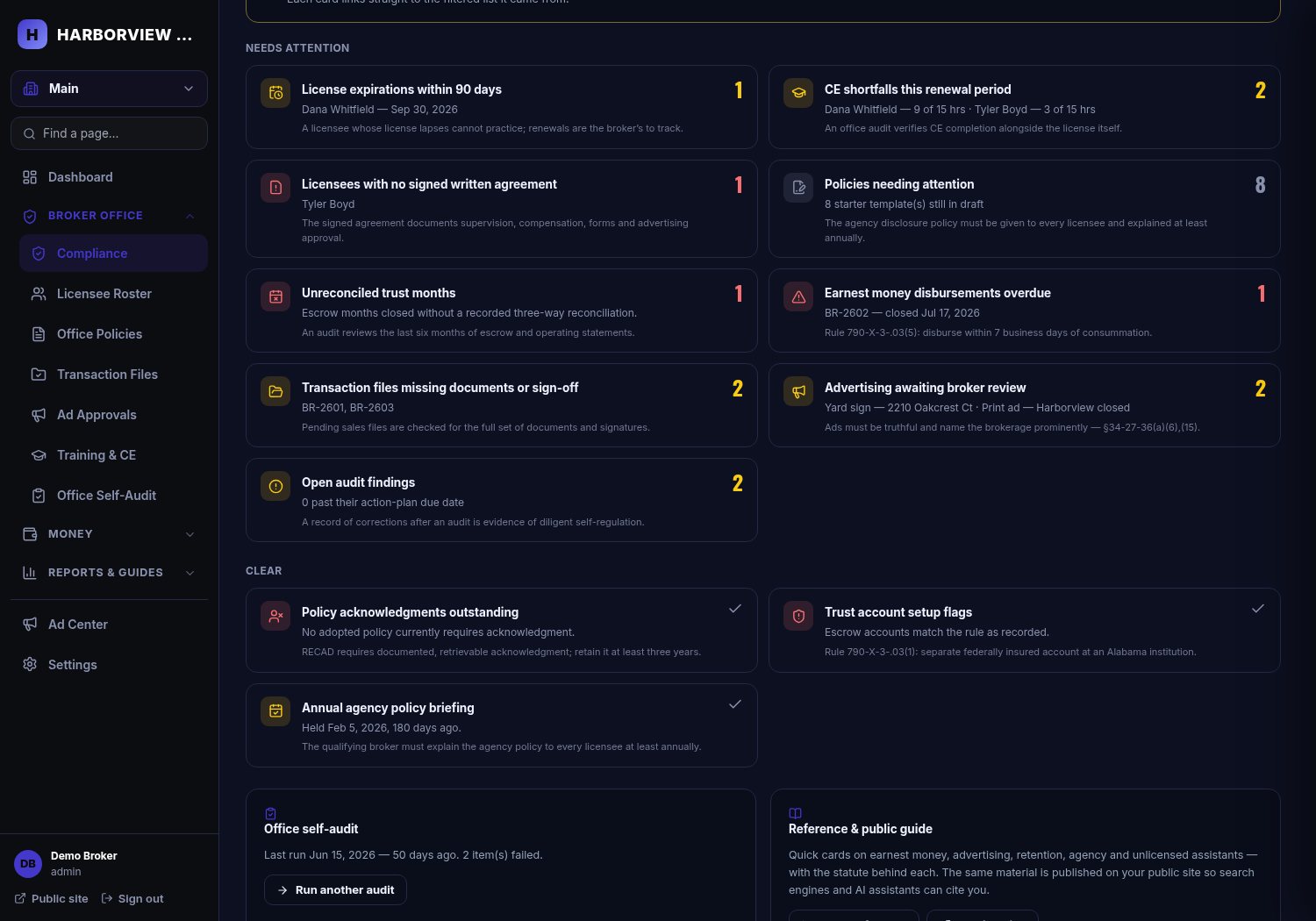
A trust ledger that reconciles three ways, every month.
Record each deposit and disbursement as it happens, against the transaction and the beneficiary it belongs to. At month end the reconciliation compares the bank statement, the journal balance and the sum of the beneficiary ledgers, and shows the variance rather than hiding it.
- Separate accounts with bank, signatories and insured status on file
- Chronological journal — deposits, disbursements, dates, references
- Beneficiary ledger totals reconciled to the journal and the bank
- Disbursement basis recorded so a release is never unexplained
- Variance flagged, and the month marked unreconciled until it is resolved
Compliance record, not a payment rail. Broker Office records money movement so it can be proven. It never initiates a transfer and never holds funds.
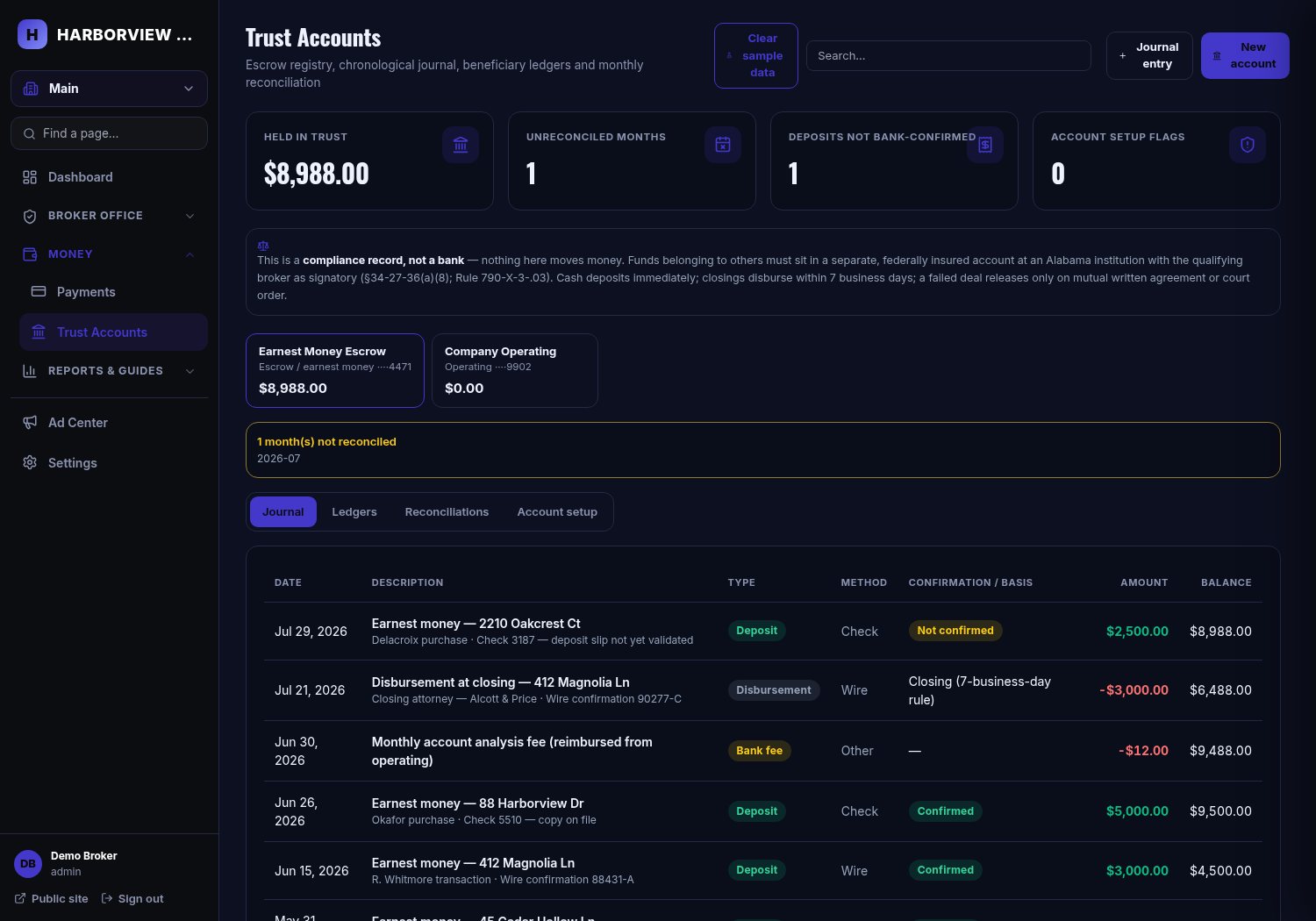
Files that cannot quietly go missing.
Every listing, sale, lease and referral gets a file with a required-document checklist, the licensee who worked it, the broker's review sign-off, and a retention-until date calculated from the closing or termination date.
- Document checklist per file — agreement, disclosure, contract, closing statement
- Broker review recorded with reviewer and date
- Deletion blocked while the retention window is open
- Terminated and rejected files retained on the same clock
- Earnest money linked to the trust account holding it
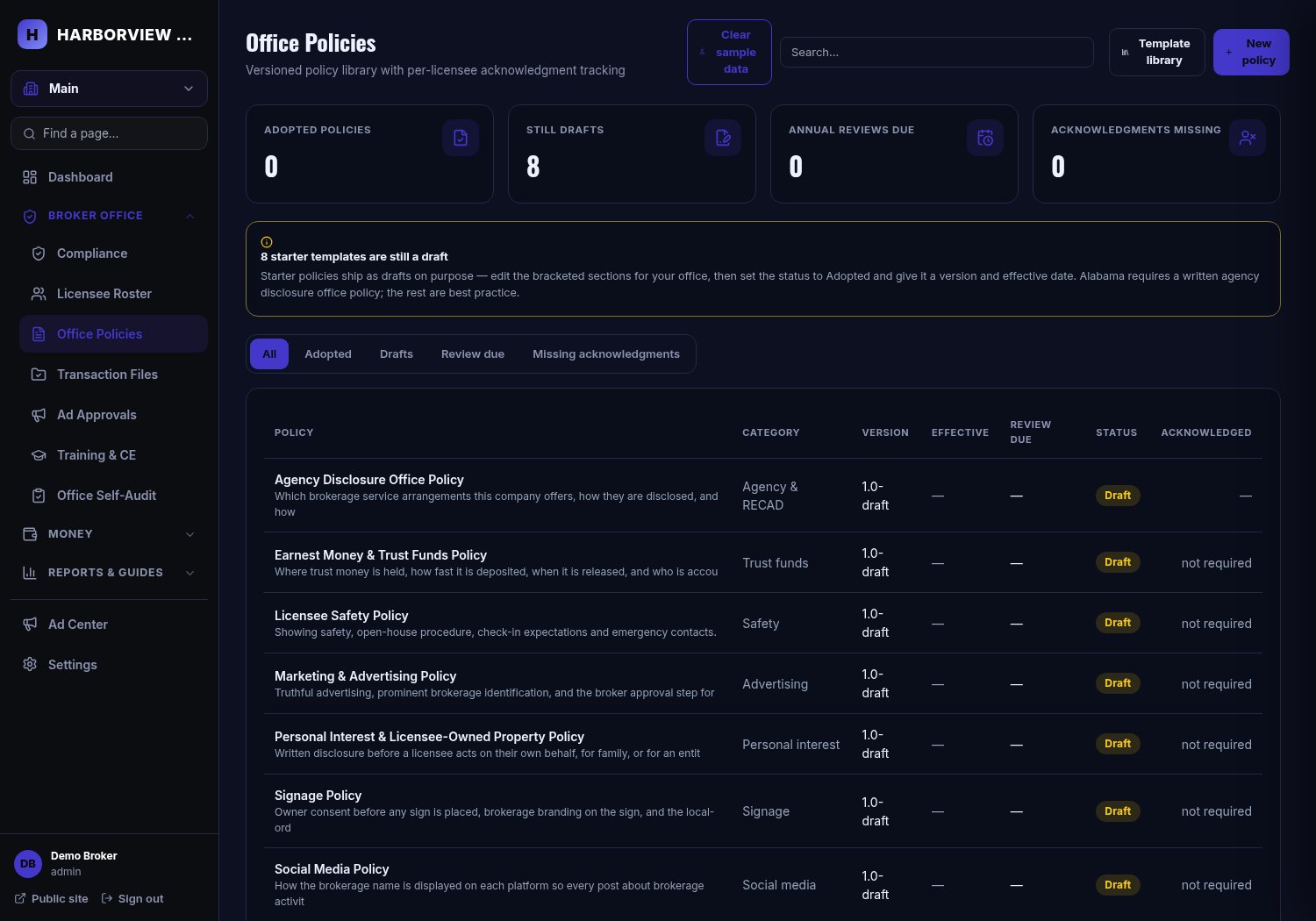
A written policy is only worth the signatures behind it.
Broker Office ships editable policy drafts — agency disclosure, advertising, trust funds, supervision, unlicensed assistants and more — each one versioned with an effective date and a review date. Assign them and track who acknowledged which version.
- Versioned policies with effective and review dates
- Per-licensee acknowledgment record, with method and date
- Missing-acknowledgment alerts when a policy is revised
- Drafts written to be edited to your firm and your state
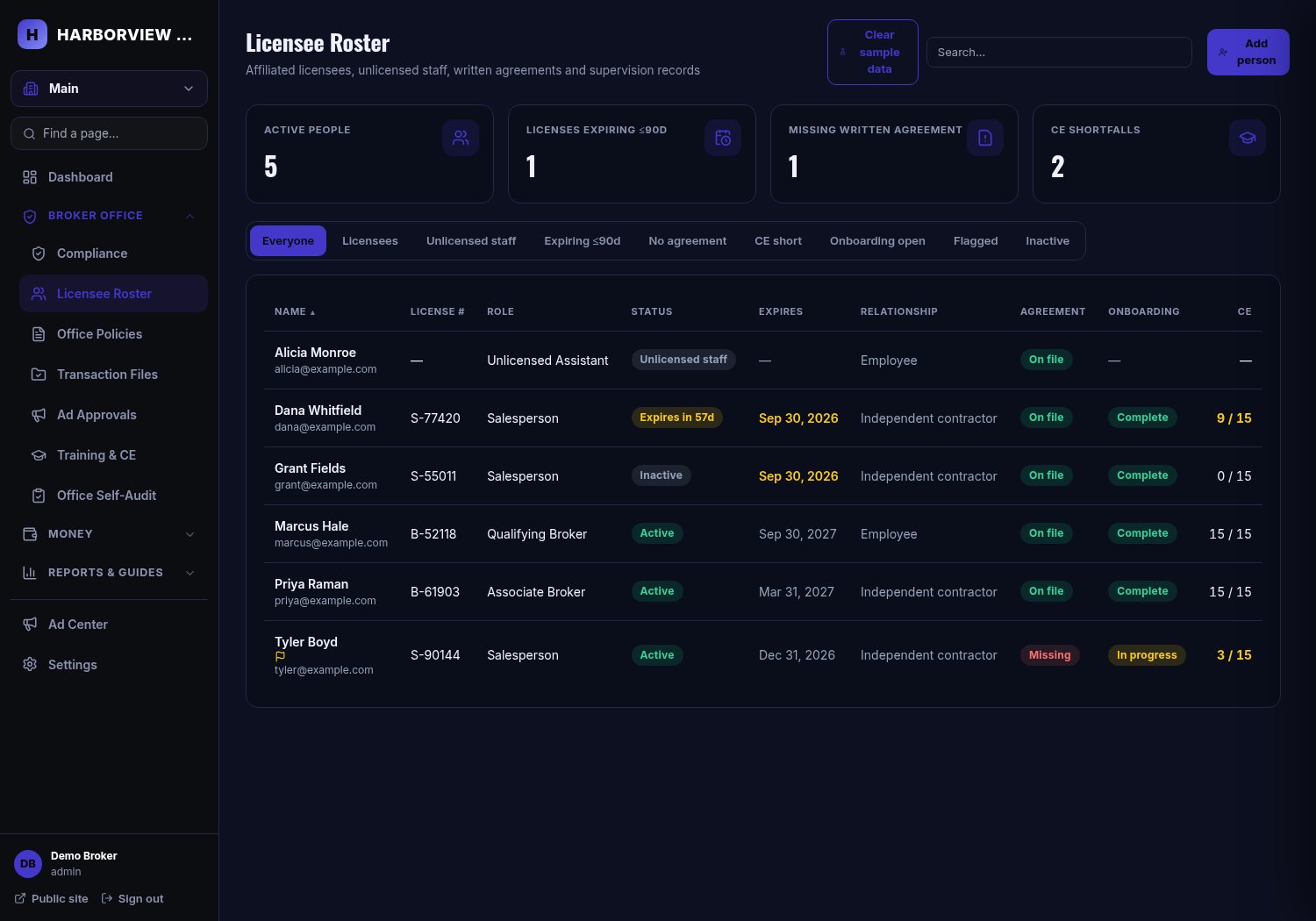
Everyone in the office, current and accounted for.
The roster is the spine of supervision: license number and type, expiration, the written agreement on file, relationship (associate broker, salesperson, unlicensed assistant), team and mentor, plus a supervision flag for anyone who needs closer oversight.
- License expirations surfaced before they lapse
- Written agreement on file, with the date it was signed
- CE hours logged by course, provider and renewal period
- Onboarding checklists for new affiliates
- In-house training sessions with attendance recorded
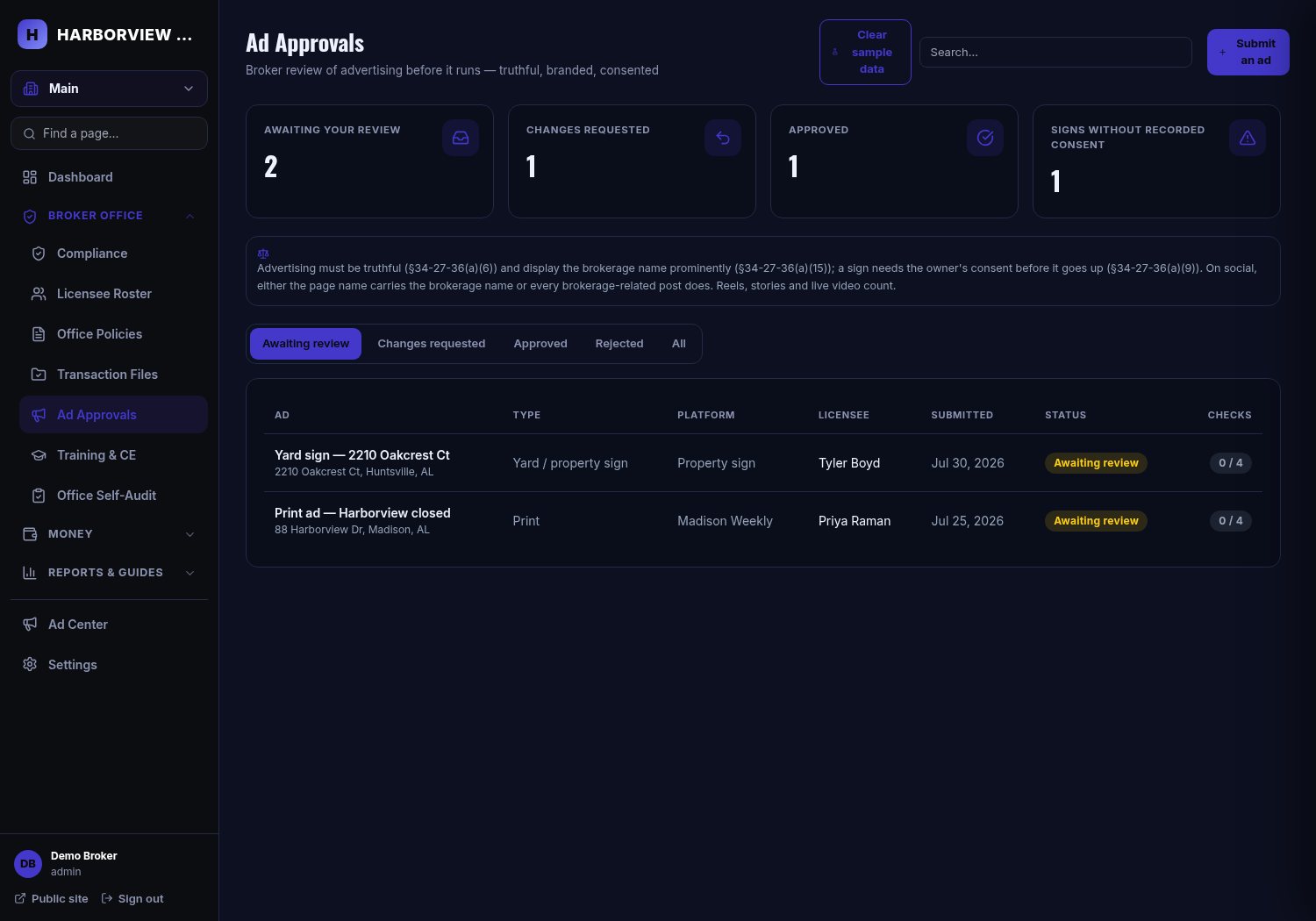
Nothing goes out without a decision on record.
Licensees submit signs, listing ads, print and social posts to a review queue. Each submission is checked against the same four questions and approved, revised or rejected — with the reviewer, the date and the reasoning saved.
- Truthful and not misleading
- Brokerage name displayed prominently
- Owner consent obtained before the property is advertised
- Local sign ordinances respected
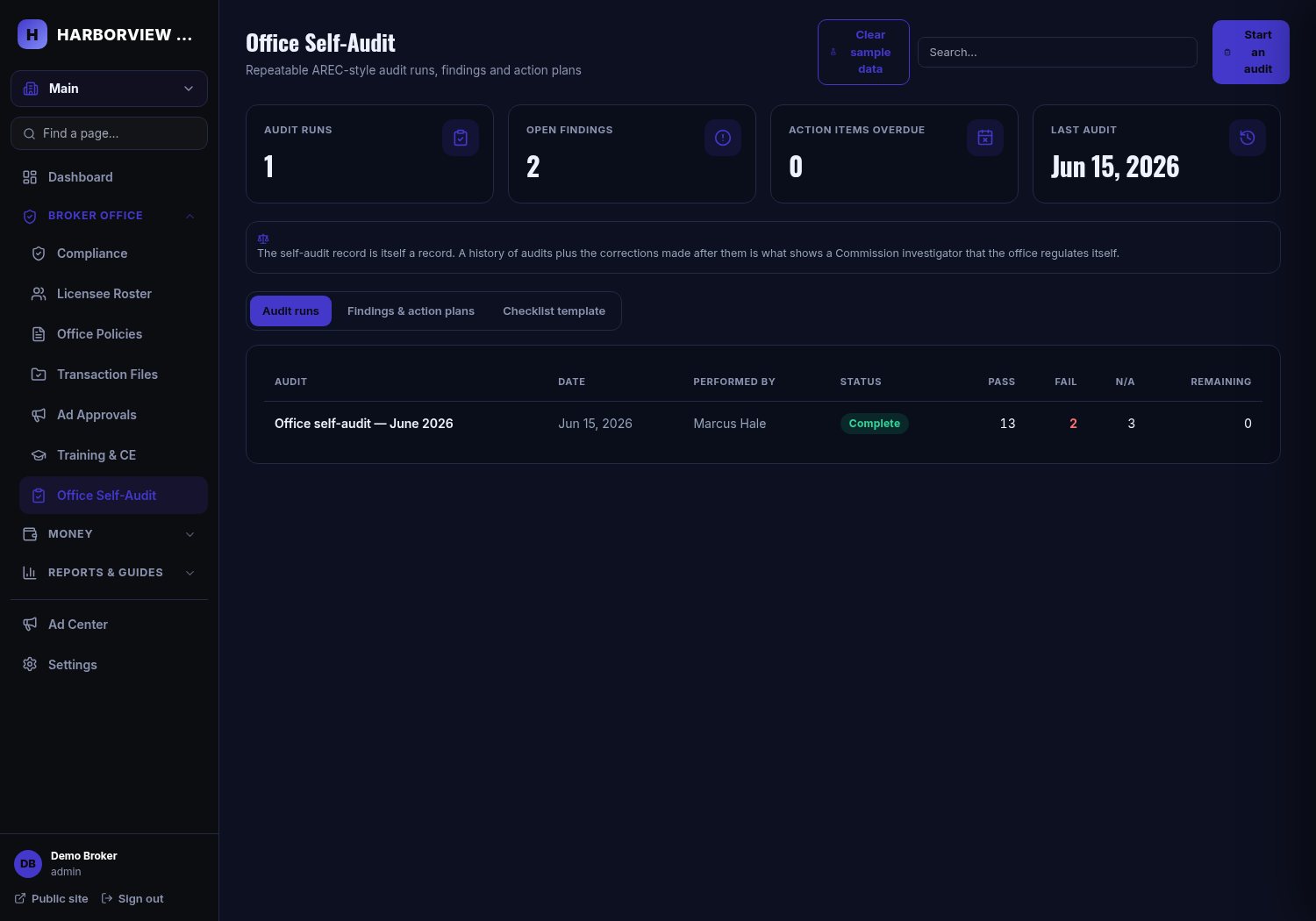
Inspect your own office before someone else does.
A repeatable checklist modeled on what an office inspection actually looks at. Run it quarterly or annually, mark each item pass, fail or not applicable, and every failure becomes a finding with a severity, an owner, a due date and an action plan that stays open until it is resolved.
- Reusable audit template — run it again next quarter
- Pass / fail / not-applicable counts per run
- Findings with severity, owner, due date and action plan
- Open findings escalate onto the compliance dashboard
The Broker Guide — ten articles that answer the questions clients ask.
Broker Office installs a public, plain-English guide on your own website. Each article is written in original prose and cites the statute or Commission rule behind it, so it earns search traffic, gets cited by AI assistants, and does the explaining before the phone rings. The same knowledge seeds your site assistant.
One platform. One login. One bill.
Broker Office is the compliance system plus a complete brokerage website with a built-in AI assistant — provisioned together, on your own subdomain or your own domain.
One flat price. Every licensee included.
No per-seat pricing, no per-transaction fee, no charge for another trust account. Add the whole office and it costs the same.
- Unlimited licensees, transaction files and trust accounts
- Public brokerage website and the Broker Guide included
- Editable policy drafts and a self-audit checklist pre-loaded
- Your own subdomain, or connect your own domain
- Self-serve setup — no approval queue, no sales call
Because these are the records someone will ask to see.
Isolated per-brokerage data
Every brokerage runs against its own database and its own file store. Nothing is shared across accounts.
Encrypted in transit
TLS on every page, public and admin. The admin is behind a login gate you create on first run.
Retention enforced in software
A transaction file inside its retention window cannot be deleted from the interface — not by an agent, not by accident.
Dated, attributable records
Acknowledgments, reviews, reconciliations and approvals all carry who did it and when, because that is the part being audited.
Encrypted off-site backups
Backups are encrypted and stored off-server, so a bad day at the office is not a records loss.
Company behind it since 2005
Built and hosted by Leadco-Insureco Marketing LLC — a technology company serving small business for two decades.
Frequently asked
Does it move or hold money?
No. The trust ledger is a compliance record. It records the deposits and disbursements your bank actually made so the journal, the beneficiary ledgers and the statement can be reconciled and proven. It never initiates a transfer and never holds funds.
Is there a per-licensee fee?
No. It is a flat $79.95 per year for the whole office — every licensee, transaction file and trust account included, with no setup fee.
Can I use it outside Alabama?
Yes. The structure — roster, policies with acknowledgments, transaction files with retention, a trust journal with three-way reconciliation, advertising review, CE and self-audit — is what license law asks of a broker everywhere. The seeded policy drafts and guide articles cite Alabama law, so edit them to your own state's rules before adopting them.
Do my agents get logins?
The admin is staff-side and gated. You create the first administrator on your own first visit, then add accounts for the broker and office staff who maintain the records.
What arrives already filled in?
Editable office policy drafts, an office self-audit checklist, an onboarding checklist, and the ten Broker Guide articles on your public site. Demo records are included so you can see how each screen works, and they are yours to delete.
How fast can I get started?
Minutes. Sign-up is self-serve — no approval queue and no sales call. Choose Broker Office during setup and the compliance system, the public site and the Broker Guide are provisioned automatically.
Be the brokerage whose file is always complete.
Set the office up once, and let the dashboard tell you what needs attention — long before anyone else asks to see it.